

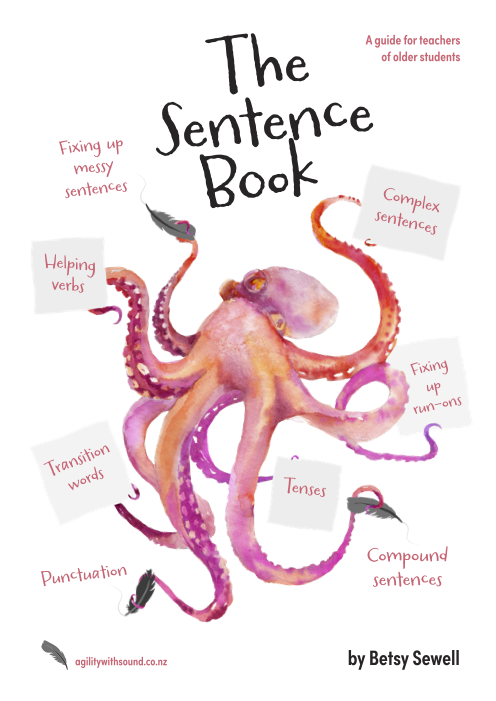
How to identify, construct and punctuate the various sentence types in English. The package includes a 102 page book, two laminated double sided tense charts , two laminated double sided transition words charts and a USB with student activities.
From the teacher tutorial section
Complex sentences also have two (or more) parts, each with a subject and a verb, but one part is dominant and can stand alone as a complete sentence (the independent clause), and the other (or others) add relevant information to it. The add-on part or parts do not make sense on their own. An add-on part is a dependent clause, because it depends on the rest of the sentence to make sense. The dependent clause, the add-on, relates directly to the rest of the sentence. It adds information to the same thought. A complex sentence, like any other sentence, is about one core thought.
Examples:
We will be staying inside today because it is raining.
We will be staying inside today is a complete sentence that makes sense on its own, but because it is raining is not and does not. It adds information, explaining why we will be staying inside. The thought in this sentence is about staying inside.
If it is raining, we will not be going on the picnic.
We will not be going on the picnic is a complete sentence that makes sense on its own, but If it is raining is not and does not. It adds information, explaining what would prevent us from going on the picnic. The sentence is about one thought: going on a picnic.
Add-ons (or dependent clauses) have three parts: a subject, a verb, and a joining word. These joining words, properly called subordinate conjunctions, explain the relationship between the add-on and the main part of the sentence. They may indicate why, when, under what conditions, and the like.
Common joining words (subordinate conjunctions) in complex sentences include the following:
Explaining why: because, since, as, so that, due to the fact that
Explaining when: before, after, when, while, whenever, until, as soon as
Explaining the conditions: if, unless, even though, as long as, provided that, whereas.
This list is far from exhaustive, but it includes the most common examples. There are many, many other words and phrases that can be used, words that indicate the relationship between the add-on (dependent clause) and the rest of the sentence (the independent clause).
Teaching examples:
Simple sentence: Jon kicked the ball. This is the independent clause.
Add-ons: These are dependent clauses.
Why? because he was closest to it.
When? when he got the chance.
These are the resulting complex sentences, with the subject underlined, the verb in bold, the conjunction in italics.
Jon kicked the ball because he was closest to it.
Jon kicked the ball when he got the chance.
Unlike compound sentences, complex sentences can be reordered to begin with the joining word. Note the comma when the sentence begins with a dependent clause.
Because he was closest to it, Jon kicked the ball.
When he got the chance, Jon kicked the ball.
Student activities, one example
How many sentences can you make? It must make sense.
I put my homework in my bag. This is the independent clause.
When These are all add-ons, or dependent clauses.
before I left school
as soon as I had finished it
after I had had breakfast
Why These are all add-ons, or dependent clauses.
because I so often forget it
because the teacher gets so mad if I forget it
because I am a naturally tidy person
due to the fact that I hate looking at it